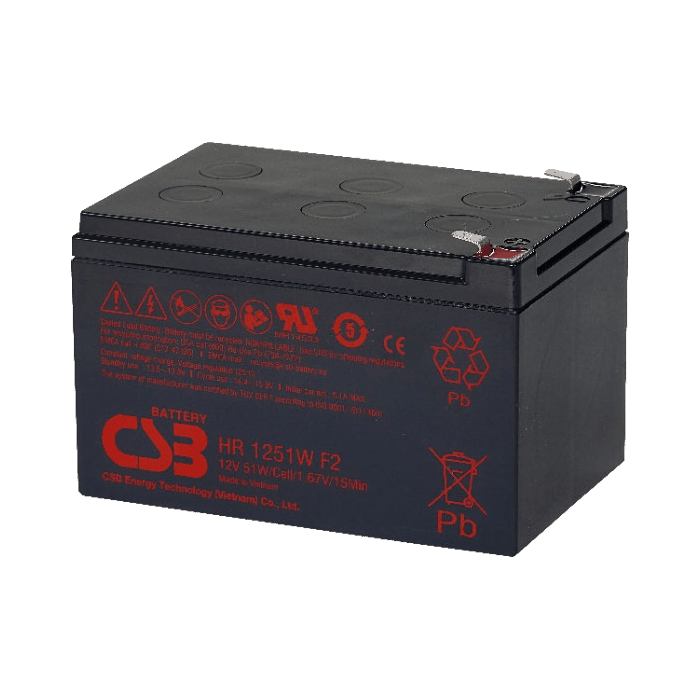
CSB HR1251W 12V 51W Valve-Regulated Sealed Lead-Acid Battery
The CSB HR1251W is a 12V valve-regulated sealed lead-acid battery belonging to the HR series of high-rate discharge pure lead batteries, with a nominal capacity of 51W @15min-rate, suitable for float standby scenarios such as data center UPS. It uses AGM technology, offers high gas recombination efficiency, and is maintenance-free by design.
Taobao store
WeChat procurement
Product Features
- Valve Regulated Lead Acid (VRLA) Battery
- Maintenance-Free, Absorbent Glass Mat (AGM) Technology for Efficient Gas Recombination of up to 99%
- Pure Lead Construction and Proprietary Elements
- Designed for High-Rate UPS, Float Service Standby Power Applications
- Built in Accordance with IEC 61056-1/2:2012 and UL1989 Recognized (MH14533)
Application Scenarios
- Small and medium data center UPS backup
- Server rack uninterruptible power supply
- Network room emergency power protection
- Medical imaging equipment UPS backup
- Industrial control UPS fast discharge
- Laboratory precision instrument backup power
Product parameters
- Model:HR1251W
- Voltage:12 Vdc
- Nominal Capacity:51W @15min-rate
- Watts per Cell:108.5 (5-Min 1.67 VPC @ 25°)
- Watts per Cell:53.3 (15-Min 1.67 VPC @ 25°)
- Max. Charge Current:5.10 A
- Max. Discharge Current:180 A
- Short Circuit Current:462 A
- Internal Resistance:13.6 mΩ
- Terminal Type:F2 terminal (Faston Tab 250)
- Container Material:ABS (UL 94-HB) standard, flame-retardant (94-V0) available upon request
- Weight:3.85 / 8.49 kg / lb.
- Length (L):151.0±2.0 / 5.94±0.08 mm / in
- Width (W):98.0±1.0 / 3.86±0.04 mm / in
- Height (H):100.3±1.5 / 3.95±0.06 mm / in
- Design Life:Up to 5 years in standby service at 25°C; Eurobat (20°C): 3-5 years, Standard Commercial
- Float Charging Voltage:13.5 - 13.8 Vdc/battery
- Equalizing Charging Voltage:14.4 - 15.0 Vdc/battery
- Operating Temperature:discharge -15°C to 50°C; charge/storage -15°C to 40°C
Product details
The CSB HR1251W is a 12V valve-regulated sealed lead-acid battery belonging to the HR series of high-rate discharge pure lead batteries, designed specifically for small-output UPS and fast-discharge standby scenarios. Its nominal capacity is 51W @15min-rate (1.67 VPC @25°C), with 108.5W per cell at the 5-minute rate and 53.3W per cell at the 15-minute rate, making it suitable for float standby applications requiring high-rate discharge, such as data center uninterruptible power supplies.
This battery uses valve-regulated lead-acid (VRLA) and absorbed glass mat (AGM) technology, with gas recombination efficiency of up to 99%, and is maintenance-free by design. The positive and negative plates use pure lead construction and a proprietary formula, supporting high-rate discharge. The battery complies with IEC 61056-1/2:2012 and is certified to UL1989 (MH14533). The case material is ABS (UL 94-HB), and a flame-retardant version (94-V0) is available on request.
At 25°C, the HR1251W has a float charge voltage of 13.5-13.8 Vdc/battery and an equalizing charge voltage of 14.4-15.0 Vdc/battery. The maximum charge current is 5.10A, the maximum discharge current is 180A, the short-circuit current is 462A, and the internal resistance is 13.6 mΩ. The terminal type is F2-Faston Tab250. Operating temperature range: discharge -15°C to 50°C, charge/storage -15°C to 40°C, with a nominal operating temperature of 25°C.
Battery dimensions are length 151.0±2.0 mm, width 98.0±1.0 mm, height 100.3±1.5 mm, and weight approximately 3.85 kg. Design life can reach 5 years in float service at 25°C, and 3-5 years per the Eurobat standard (20°C). The self-discharge rate is less than 10% after 90 days at 25°C, and the battery can be stored for up to 6 months; it must be fully charged before use; if storage temperature exceeds 25°C, charge it earlier.
The HR1251W is suitable for applications requiring high-rate discharge and reliable backup power, such as data center UPS, and its pure lead design and AGM technology help provide stable performance in float standby applications. During installation, ensure terminals are securely connected and follow the recommended charge voltage and temperature ranges to make the most of the battery's design characteristics.